Leitz Hektor 2,8cm f/6.3 nickel version
| original name | Leitz Hektor f=2,8cm 1:6,3 |
| lens mount | LTM |
| code | HOPPY |
| production period | 1935 - 1953 (nickel and chrome) |
| serial number - year | 273642 - year 1935 |
| production in the year | total would not exceed 600 units in chrome |
| serial number range | 250001 up to 790000 (nickel and chrome) |
| total production | 9.649 units in nickel and chrome |
| lens material | nickel plated brass |
| minimum aperture | f/25 |
| optical design | 5 elements in 3 groups |
| diaphragm | 6 blades |
| infinity lock | yes |
| nearest focusing distance | 1 mt |
| angle of view | 75,4° |
| lens hood | SOOHN |
| filter mount | A36 |
| lens weight | 103 gr |
| lens hood weight | 20 gr |
| lens maximum diameter | 3,6 cm |
| lens length (min focus/infinity) | 1,35 cm / 1,30 cm |
| lens length with lens hood (min focus/infinity) | 2,85 cm / 2,80 cm |
| notes | diaphragm in European scale |
 The Leitz Hektor 2,8cm f/6,3 is one of the most iconic and prestige lens within the annals of photography. This 28mm focal length lens, with a very interesting history and distinct technical characteristics, was designed and produced from the mid-1930s to the early 1950s by Leitz (now Leica) representing for that period the widest available wide-angle for the 35mm film format Leica cameras.
Thus, with due respect, the particular features have found their place among professional experts as some important collecting and memorable object with a certain sense of photography history.
 This Leitz Hektor 2,8cm f/6.3 was designed and specifically made for the cameras of the Leica III series using the M39 screw mount (LTM). This is one of the very pioneering approaches of the Company toward compact wide-angle design.
It was introduced in 1935, a period when Leitz consolidated a position of one of the leaders on the high class optical camera market. It was designed by Max Berek, the designer of many of the foundational Leitz lenses (he designed a total of 23 lenses). The "Hektor" name was in honor of Berek's dog, continuing a tradition of personal naming started with the famous Elmar lens (where the name is a combination of Ernst Leitz and Max Berek).
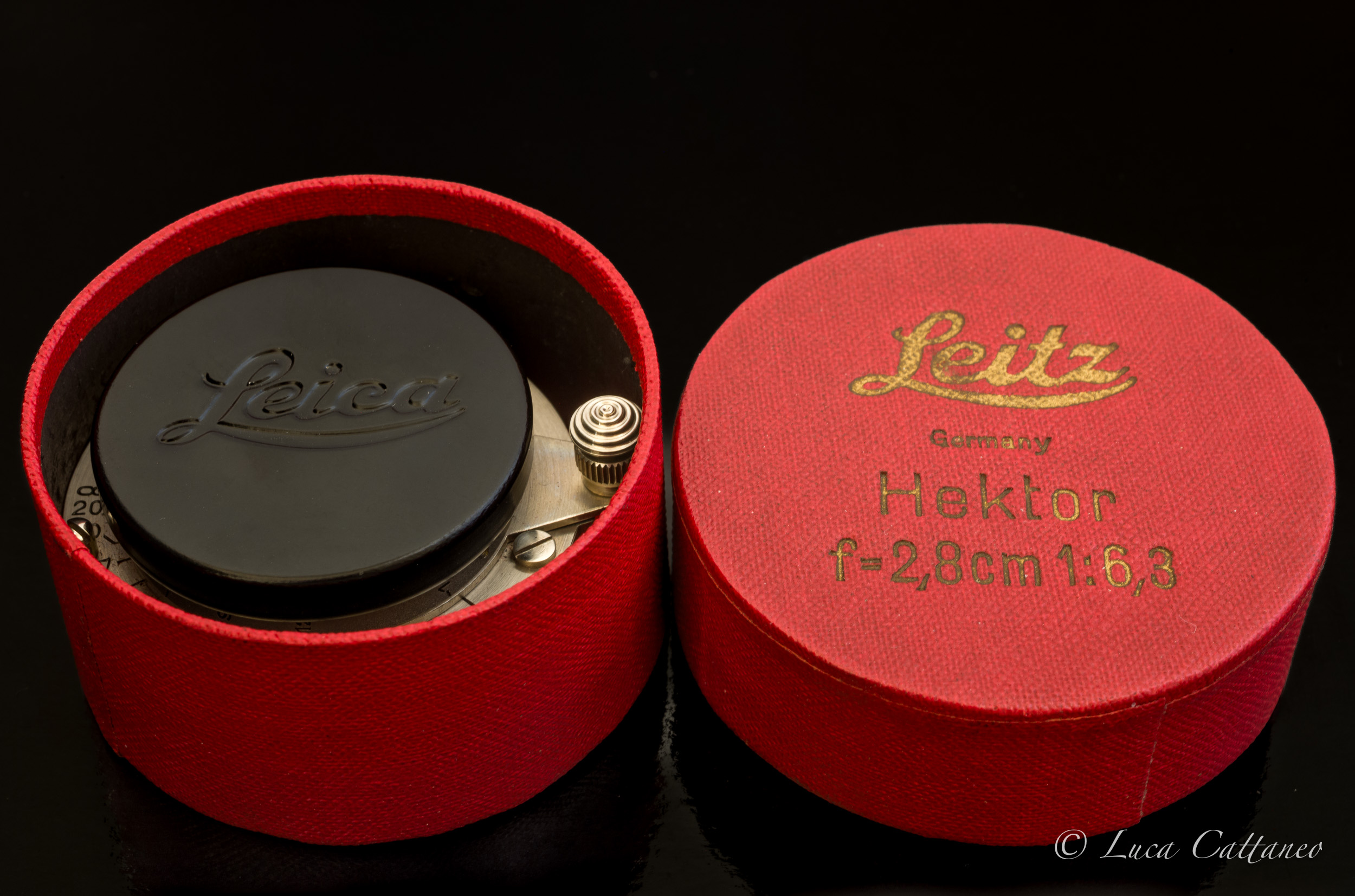 There are two finish versions of the Leitz Hektor 2,8 cm f/6.3:
a) Nickel version
The first series is shiny and has a polished finish. The handcrafted nickel finish gave it an elegant prestigious look and offered good resistance to corrosion, thus protecting the optics from the elements. On the other hand, compared to the later chrome version, more care was required in the surface treatment. The barrels were made of brass.
Production quantity: while exact production numbers for the nickel version are not definitively documented, estimates suggest that approximately 200 units were made. However, some researchers argue that the actual number may be slightly higher, although it is generally agreed that the total would not exceed 600 units.
b) Chrome version
Not too long afterward, Leitz began using chrome for coating the lens barrels; much more modern, reflective, and durable in comparison with nickel. This greatly improved durability and resistance to corrosion, making it far more practical for everyday use. These barrels were also fabricated from brass. This variant is more common and forms the majority of the units manufactured.
One of the characteristic of the Hektor 2,8cm f/6.3 is the diaphragm control.
Unlike most modern lenses, the aperture on this Hektor is controlled via a small lever on the front of the lens.
The scale values are not as in the International standard aperture ones (as used on modern lens), but it's basically the scale as used for European apertures during the 1930s. In the European version aperture values on this Leitz Hektor 2,8cm f/6.3 are engraved on a numerical scale from f/6.3 at maximum aperture up to f/25 at minimum aperture, with steps for f/9, f/12.5, f/18, and f/25.
These correspond to ordinary stop intervals, and the finicking and smooth adjustment with the lever affords very precise control, typical of Leitz craftsmanship.
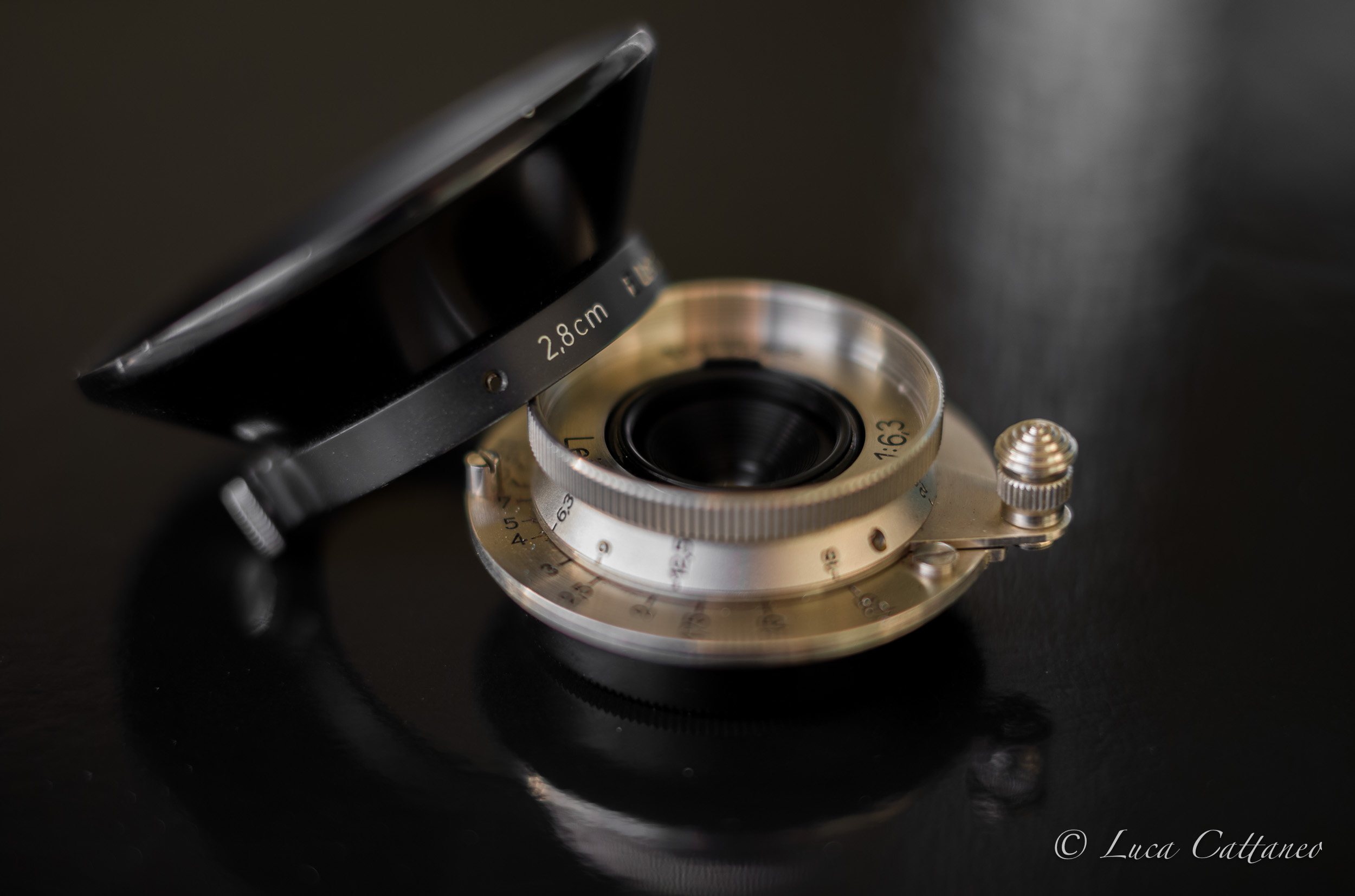 The optical design of the Leitz Hektor 2,8 cm f/6.3 is pretty simple in design and very effective: 5 lenses in 3 optical groups. The resulting optical formula develops a remarkably low degree of chromatic aberration and geometric distortions despite its compact build.
Centrally it's pretty sharp, but not quite so keen at the edges - comments on the Leitz Hektor 2,8 cm f/6.3.
Even at maximum f/6.3, the image is fairly sharp; however image quality drops off heavily near the edges, which this lens tends to do because of a somewhat simple optical design and its lack of advanced coatings.
f/9 and f/12.5 apertures are sharp, quite up to date, in order to get maximum definition, while defocused edges will take part creatively in environmental portraits or enhance the feeling of depth in images with marked perspective.
 We get rather noticeable vignetting starting from aperture f/6.3 onwards, where from corner and edge to middle, the light fall off would be quite a lot. Getting the aperture closer and dim, however till the light fall off actually reduces radically. Actually, such vignetting may optically help and draw the user's attention at the main model 's subject artistically; on one side, assuredly this means some post-pro and correction to achieve even exposure.
The distortion from barrel is moderate for a 1930s wide-angle and shows the gentle barrel distortion characteristic of older wide-angles. The optical design of the Hektor here is quite simple, yet it gives very good results against both horizontal and vertical lines with very few corrections.
There is usually low contrast, mostly under well lit conditions; this is so because the older models lack an anti-reflective coating.
This Leitz Hektor 2,8 cm f/6.3 has the tendency for pictures in warm flat tones, this can be just right for the prevailing mood of scenes it captures or so typical to many uncoated lenses of such an epoch, and then a current 1930/40s range of lenses production. This retro character is coveted today for his "atmospheric" photos, often labeled "evocative.".
The Hektor's uncoated optics are quite prone to flare and ghosting, and using the dedicated hood SOOHN is merely an essential drill in controlling these effects in difficult lighting conditions. The wide-angle design of the Hektor 2,8 cm f/6.3 allows for great depth of field, providing sharp focus from 1 meter onward.
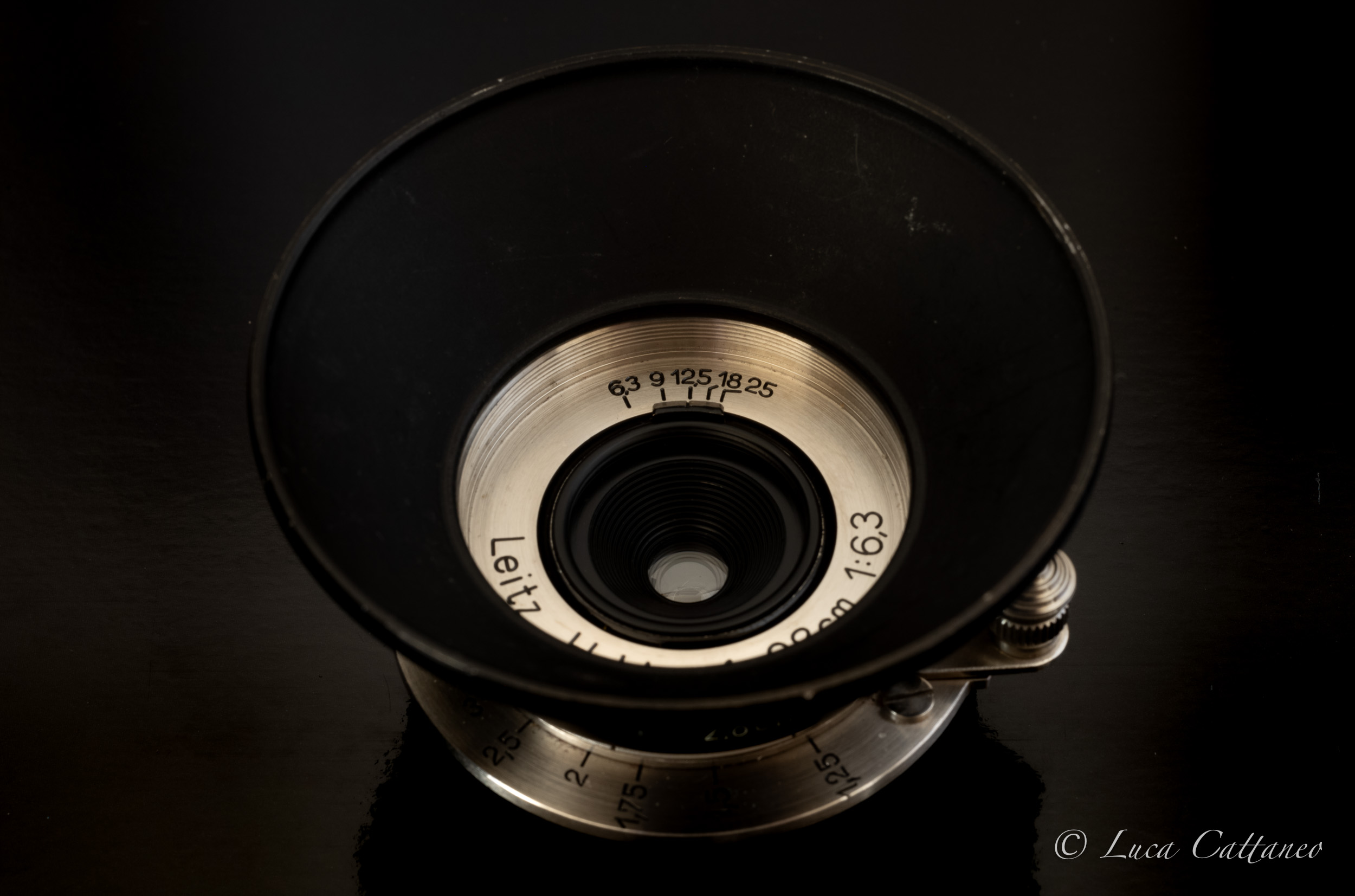 The 1935 Leitz Hektor 2,8 cm f/6.3 was state of the art for wide-angle work made for 35mm format cameras. This relatively tiny lens found favour among landscape and documentary shooters working with screw-mount Leica cameras, but a maximum aperture of f/6.3 curbed applications to low daylight conditions.
Rarity and collector value exceedingly elusive from the chrome types, the rarity and desirability are more evident in this all nickel variant. Consequent to a much lower production of about only 1.700 examples, very well preserved copies with legible markings practically rarely come up for sale and are rather expensive. More common but preferred for actual use on cameras is the chromium type.
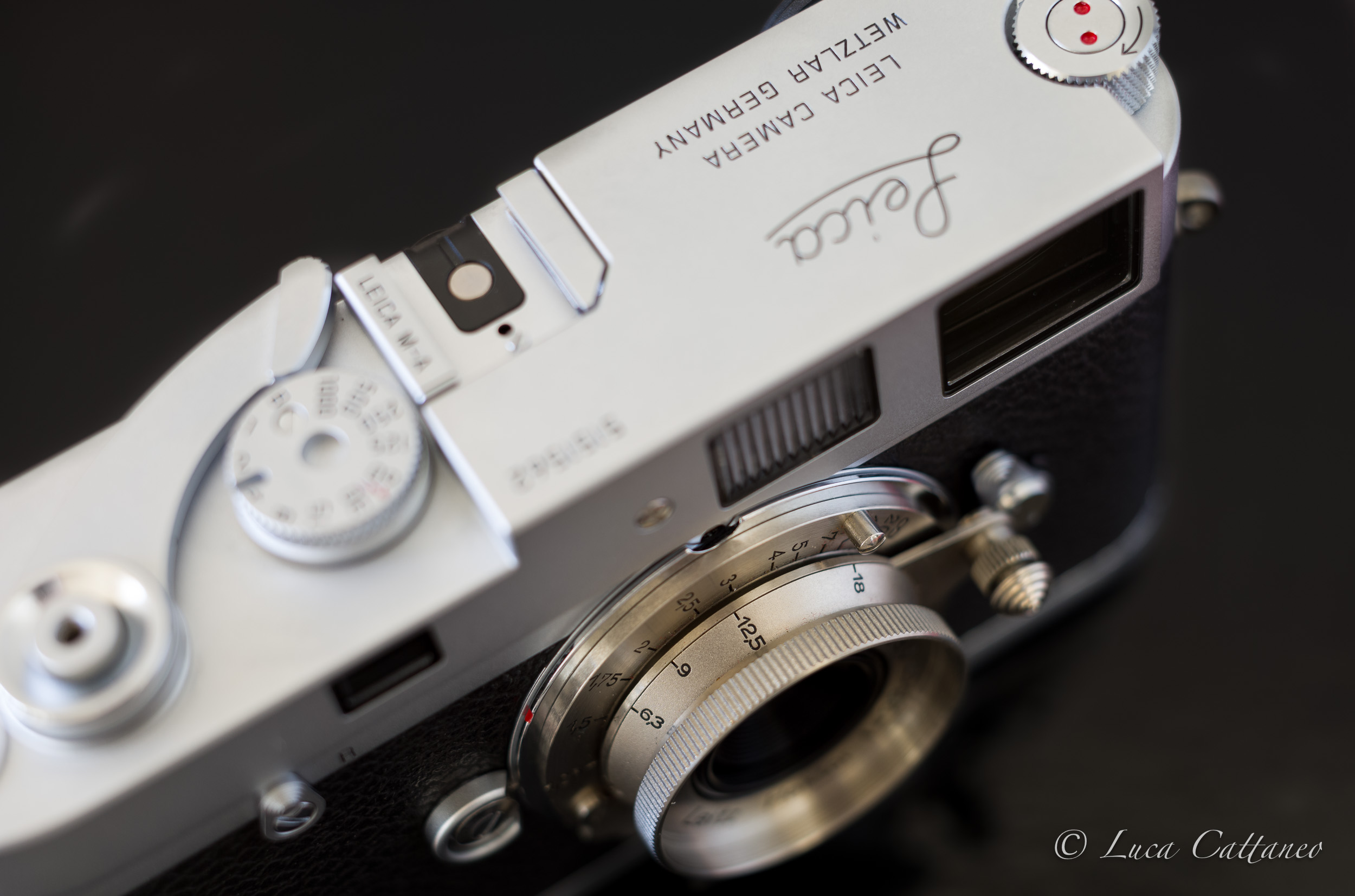 The Leitz Hektor 2,8 cm f/6.3 is popular among collectors because of a combination of optical quality, craftsmanship, and historical significance. It was one of the first lenses able to exploit fully the Leica cameras and to diffuse Leica as synonymous with excellence in professional photography. For their pictorial quality and vintage "softness," collectors especially prize the Hektor 2,8 cm f/6.3. The lens is often described as one that even in a very everyday scene, will turn into a shot full of nostalgia. Thus, the Hektor will be interesting in some artistic projects and also in experiments with the aesthetic of an analog done on digital cameras using an appropriate adapter.
 Conclusion
The Leitz Hektor 2,8 cm f/6.3 is one of the milestones in wide-angle lenses which marked a beginning and left their indelible mark on the world of photography. It still is one of the most cherished and chased optics in photographic history, either for its "vintage render" or "historical impact." Along with such great build quality, it is truly an icon of continuity in innovation at Leitz. This is a lens with strong echoes of the compactness and optical precision philosophy belonging to Leica, although one has to excuse some of the lens shortcomings purely on technical limitation grounds of that particular age.
Though not especially fast, its exemplary construction and unique "optical character" have kept it in the top flight of professional photographers' and expert collectors' preferences. Sharp images, characteristic bokeh, and low distortion make it an excellent choice for those seeking a high-quality wide-angle lens with a strong historical component.
It is in this respect that the Hektor 2,8 cm f/6.3 stands out as the best example through which Leica contributed to the development of photographic tools that, besides being technically perfect even today, offer valuable historical and emotional meaning to photographic art.
All the images were taken with a Leica Summicron-M APO 50mm f/2 ASPH plus Leitz OUFRO ring.